Research → open source
ProvenanceKit.
Every work has a history. How do we keep it?
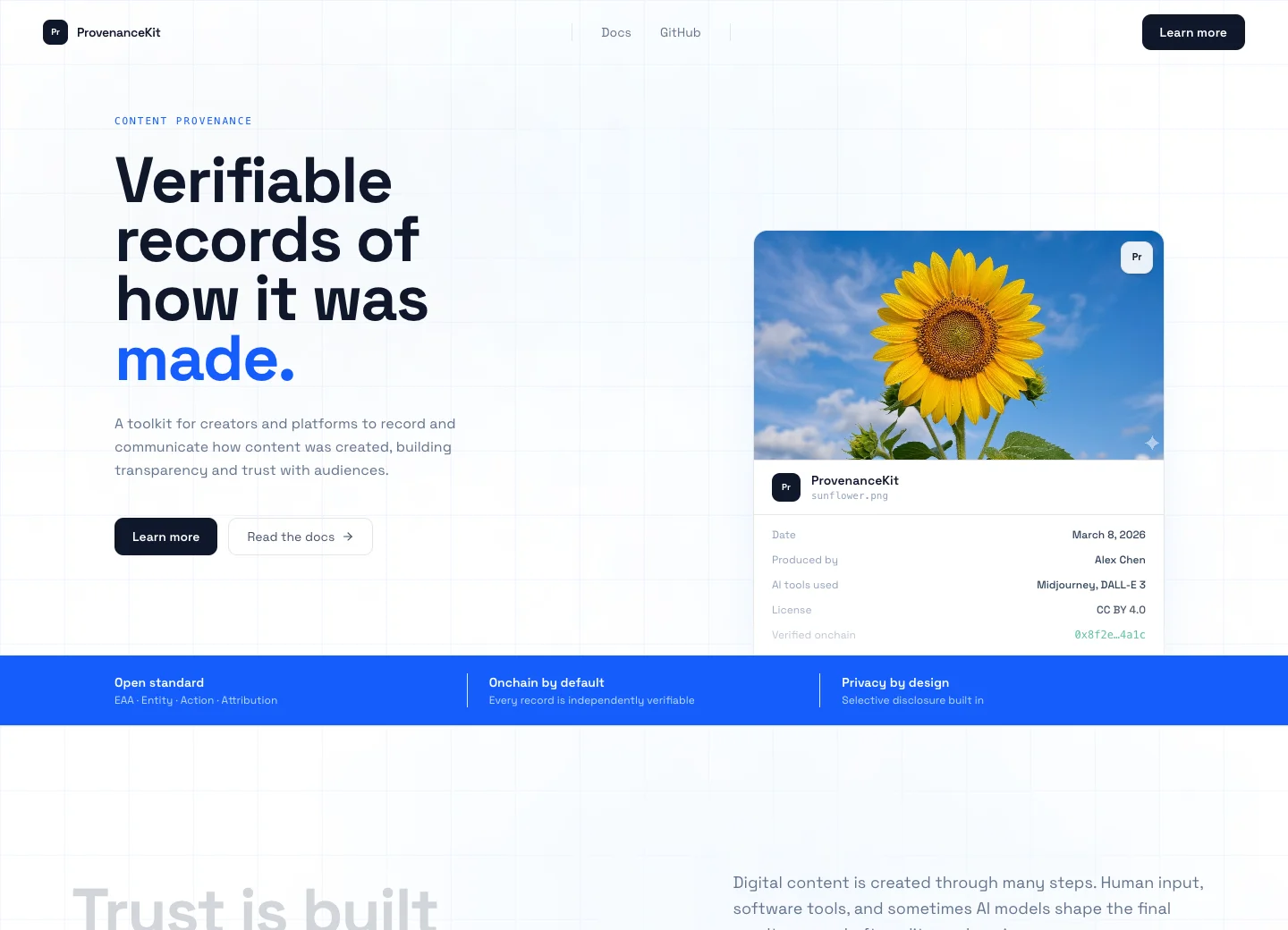
An image, article, or piece of code rarely tells you everything that went into it. Once people and AI systems create together, that missing history becomes consequential. I wanted to make the process visible while it was happening.
Begin with the information that is missing
My master’s research treated the governance of human–AI work as an information problem. Before anyone can assess contribution, permission, or responsibility, they need a useful account of who did what. I used Design Science Research to connect analysis of EU, US, and WIPO frameworks with explicit requirements for a working system.
The result was the Entity–Action–Attribution model: a small core for representing participants, the steps they take, and the contributions linked to a work. Resources and derivation relationships connect those records into a workflow history. Typed extensions carry information about AI involvement, licences, and authorisation without overloading the core.
Make the research something people can build with
ProvenanceKit turns that approach into an open-source framework with a TypeScript SDK, storage and indexing layers, privacy tools, media integrations, and optional onchain verification. It is designed to fit into an application’s existing creation process, so recording provenance can become a normal part of making something.
The thesis demonstrated the approach in representative prototypes and evaluated it against the derived requirements. That establishes design feasibility; it leaves independent, adversarial, and large-scale evaluation as further work. A tamper-evident record also depends on the quality of what gets captured. I see the toolkit as infrastructure for better-informed judgment, with a longer-term ambition to make credit, rights, and rewards easier to connect to contribution.
Some doors into the project, its origins, and the people around it.